
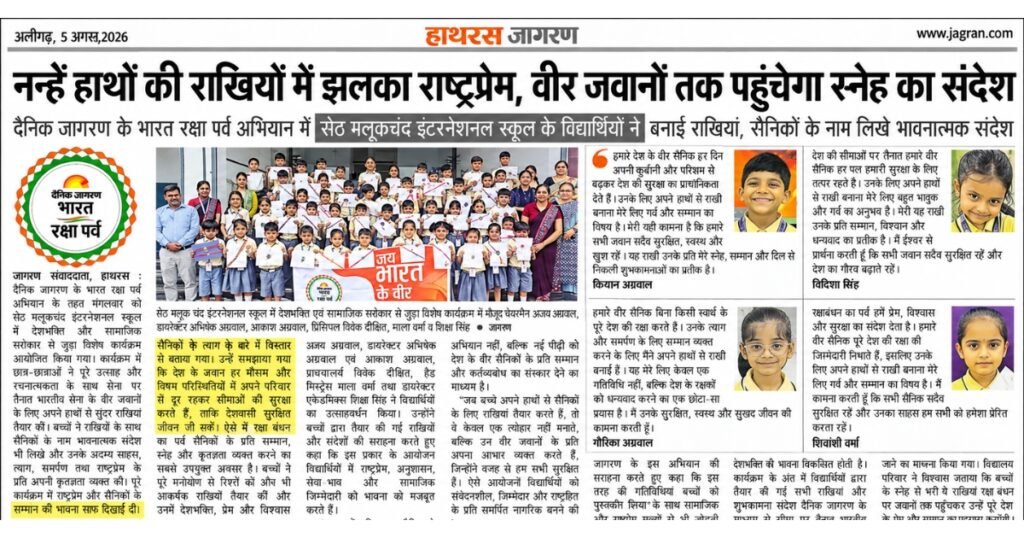
Rakhi for soldiers, made by hand in Sasni
The idea was simple. Instead of buying rakhis, students would make them, and instead of tying them on a sibling, they would send them to the men and women guarding the country. Children from the youngest classes upward sat down with thread, card, glitter and a lot of saffron, white and green, and turned out rakhis built around the tricolour.
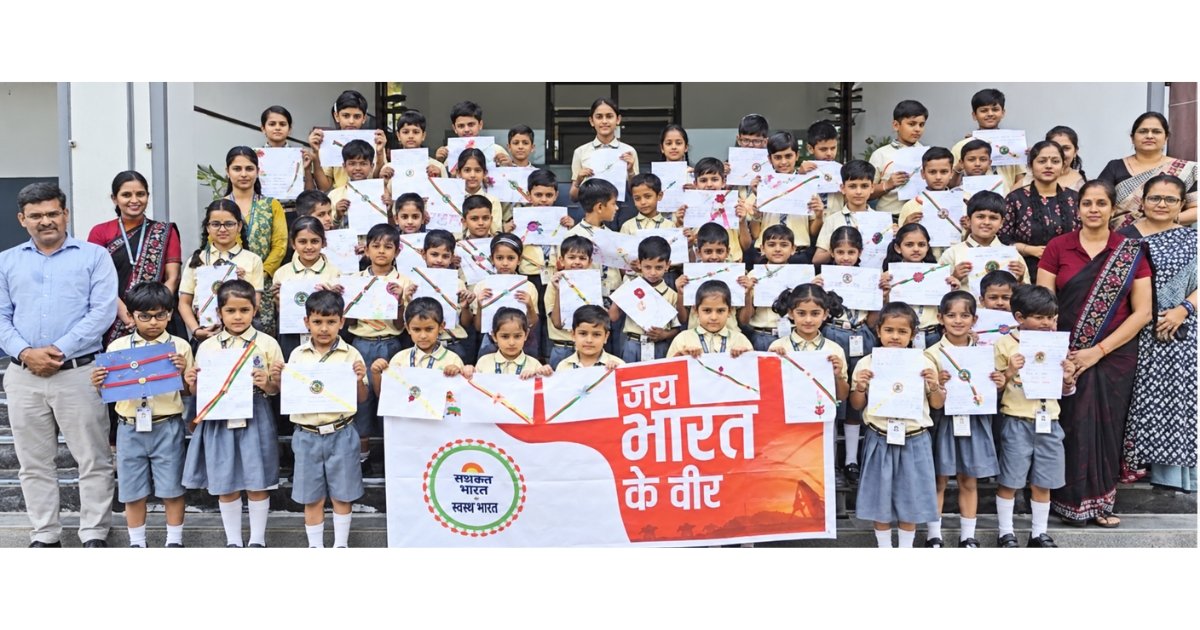
Each rakhi came with a handwritten message addressed to a soldier. These were not copied lines from a board. They were the children’s own words, some wobbly, some very neat, about courage, sacrifice and gratitude. In the photograph the school shared, rows of students hold their cards up to the camera in front of a banner that reads “Jai Bharat Ke Veer”, and almost every face is looking straight at the lens, clearly proud of what they made.
What the children learned before they picked up the thread
Before the craft work began, teachers spoke to the students about the role of the Indian Army and what soldiers give up to do their job. The children heard how Jawans stay away from their families through every season and in hard, often dangerous conditions so that people like them can sleep safely at home.
That context matters. A child who makes a rakhi without knowing who it is for learns a craft. A child who makes the same rakhi after hearing about a soldier standing guard through a freezing night at a high border post learns something else. The teachers framed Raksha Bandhan as the right moment to say thank you, because the festival itself is about protection, and nobody protects the country the way soldiers do.
In their own words, four young voices
Several students shared what making the rakhi meant to them, and their words were printed alongside the report.
Kiyan Agrawal said soldiers put the safety of the country above their own happiness and family, and that making a rakhi with his own hands for them felt like a matter of pride and honour. He wished every Jawan a safe, healthy and happy life and called his rakhi a sign of love and respect from the heart.
Riddhima Singh said making the rakhi was both emotional and a proud moment for her. For her it stands for respect, trust and thanks, and she prays that every soldier stays safe and keeps making the country proud.
Gaurika Agrawal described it as more than an activity. It was, in her words, a small way of saying thank you to the people who protect the country without asking for anything in return.
Shivanshi Verma reminded everyone that Raksha Bandhan is a festival of love, trust and protection. Since soldiers carry the duty of protecting the whole nation, she said, making a rakhi for them felt like an honour, and their courage keeps inspiring all of us.
It is hard to read those lines and not smile. They are simple, sincere and a little formal in the way children get when they know something is important.
Bharat Raksha Parv 2026 and the school leadership
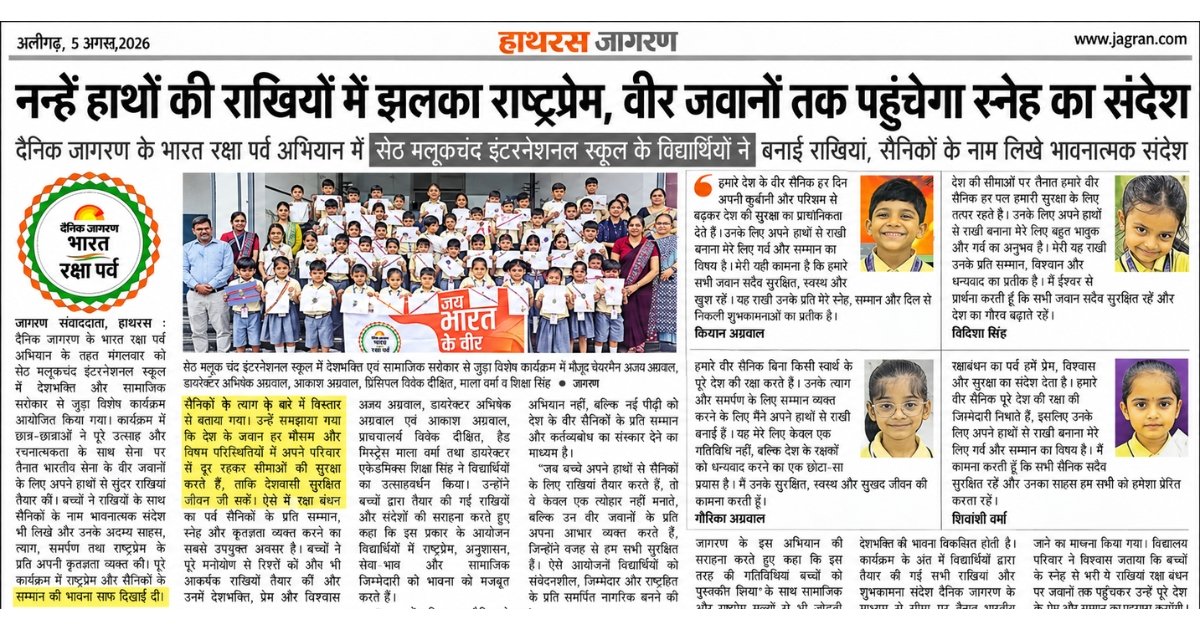
Chairman Shri Ajay Agrawal, Directors Abhishek Agrawal and Aakash Agrawal, Principal Vivek Dixit, Headmistress Mala Verma and Director Academics Shikha Singh were present and encouraged the students throughout. They looked over the finished rakhis and messages and praised the effort that had gone into them.
Principal Vivek Dixit said that Bharat Raksha Parv is not just a campaign. It is a way of building respect and a sense of duty toward soldiers in the next generation. When children make rakhis for jawans, he said, they are not only celebrating a festival, they are thanking the people who keep everyone safe. Programmes like this, in his view, help students grow into sensitive, responsible and patriotic citizens.
The school family also thanked Dainik Jagran for running the campaign. Activities like this, they said, connect children with social and national values that go beyond textbooks, and help them build a habit of service and respect.
Why this matters for a CBSE school in Sasni, Hathras
A good school teaches children to read, write and solve problems. A better one also teaches them who to be grateful to. SMCIS, a CBSE school in Sasni on the Aligarh-Agra Road, works by the line “Learning Today, Leading Tomorrow,” and 5 August 2026 was a clear example of the second half of that promise.
No exam will ever ask these children to explain what a soldier sacrifices. But the ones who sat with a half-finished tricolour rakhi, thinking about who would receive it, now have an answer anyway.
From Sasni to the border
At the end of the programme, every rakhi and every greeting card was collected so that it could be sent, through Dainik Jagran, to the soldiers posted on the border. The school family said they are confident these rakhis, filled with the children’s affection, will reach the jawans and remind them that the whole country is grateful.
Somewhere on a border post, a soldier may open an envelope and find a slightly crooked rakhi from a child in Sasni. That is the whole point.